
A new consumer has arrived; ingredient-literate, sustainability-conscious, and demanding proof.
The beauty industry is moving beyond the natural-versus-synthetic debate. The market signal is clear and more exacting than ever: consumers want proof, precision, and performance, and they expect brands to show their work.
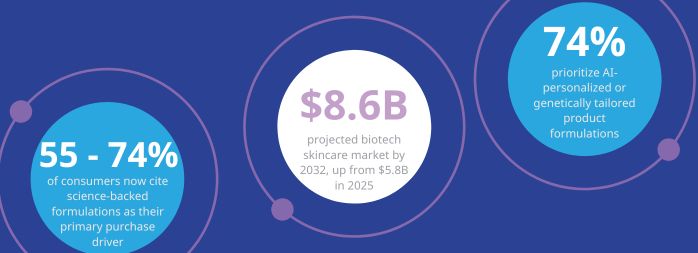
Something fundamental is shifting in personal care. The category is moving from ingredient origin to ingredient performance because consumers are no longer content to take beauty at face value. Shaped by influencer fatigue, corporate skepticism, misinformation, and a stronger desire for control, they are using their dollars to demand visible, substantiated verification. The years of “natural” and “clean” as seals of safety or efficacy have passed, thanks to greenwashing and dirty labeling. Today’s consumer wants to know what is in the product, at what concentration, who validated it, and how it was sourced. The brands that win will be the ones that can answer clearly, using biotechnology, biomimetics, and science to advance sustainability.
The Technology Integration
Technology is reshaping both how skincare is evaluated at the point of sale and how formulations are designed at the bench.
Proof & Performance Over Pretend
Skincare claim substantiation is shifting away from broad language like “dermatologically tested” or “clinically proven.” What matters now is specificity. Data-backed claims, quantified results, and before-and-after visuals are moving onto packaging and into the shelf experience. What started with multinationals is quickly becoming expected across the category, driven by consumers who want to see proof, not just be told.
Market data reinforces this shift. Only 2% of 2024 product launches across Mintel were classified as fully natural, yet science-validated sustainable claims grew 1.5% faster than the overall category. Growth is concentrating on proof, not positioning alone.
“Stardusting,” the practice of adding trace amounts of a trending ingredient for marketing without meaningful concentration, is being called out publicly and penalized on the shelf.

Everything now lands in the PIT of scrutiny, pushed, challenged, and reduced to what holds up. Consumers still want plants, sustainability, and ethical sourcing. They just expect the science to back it up.
Proof Demanding
77% of facial skincare buyers want clinical trial results on packaging, not buried online. Before-and-after evidence and quantified claims build trust. AI is accelerating that expectation, forcing real-time validation of what’s in the formula and what it delivers. It creates demand for ingredient-level substantiation, clinical end-result validation, quantified claims, and before-and-after proof.
Ingredient Inspections
Consumers cross-reference INCI lists, scan with AI apps (OCR, databases), and check concentrations against claims. Carefully curated claim stacking is being picked apart through ingredient scrutiny and real-time searches.
Tech-Powered Verification
AI facial analysis maps skin conditions and filters for allergens, sensitivities, and routines in real time. It enables personalized selection, claim cross-checking, and faster decisions. When products can be analyzed instantly, brands must prove performance immediately.
The Science Infrastructure
Biotech actives encompass lab-engineered ingredients that mimic or enhance biological function, fermentation-derived compounds with superior bioavailability, and biomimetic systems aligned with skin architecture. Controlled production ensures consistency, optimized molecules enable targeted efficacy, and traceable sourcing provides transparency. Biotech eliminates variability from seasonal shifts, inconsistent actives, and sustainability-performance trade-offs.

Biotech: Sustainability Through Creation
Biotechnology is one of the most compelling answers to the tension between efficacy and sustainability. When bioengineered squalane is produced through sugar fermentation instead of shark liver oil, or when advanced plant cell cultures deliver greater consistency than wild-harvested botanicals, the lab becomes an act of stewardship, not compromise. See more on how here
The biotech skincare ingredients market reached USD 7.83 billion in 2025, projected to hit USD 13.66 billion by 2033 at 7.2% CAGR, with North America leading growth. Consumer hesitation toward bioengineered actives dropped as education highlights sourcing narratives and clinical validation.
Biomimetics: Biology-Informed Design
Biomimetics focuses on designing ingredients that are informed by the structure and function of living systems. Unlike biotechnology, which uses biological processes to create actives, biomimetic approaches prioritize compatibility with the skin’s natural architecture and signaling pathways. Opposed to conventional extraction, biomimetics designs ingredients to function in alignment with the skin’s own repair, barrier, and regeneration mechanisms, producing performance that feels intuitive to the skin while delivering measurable outcomes.
Key examples include skin-identical lipids, structure-mimicking delivery systems, signaling peptides, and bioinspired complexes. The market was valued at USD 2.3 billion in 2024, forecasted to reach USD 4.8 billion by 2034 at 7.8% CAGR.
A biomimetic cleansing system derived from olive oil lipids, designed to mirror the skin’s natural lipid composition while effectively removing impurities. It enables gentle emulsification of oils and debris without disrupting barrier integrity, maintaining skin compatibility and preventing delipidification for a balanced, conditioned after-feel.
SKINMIMICS® PRO MB
A skin-identical ceramide and ceramide precursor system designed to deliver clinically validated barrier optimization. It provides both structural lipid components and the biological precursors required for endogenous ceramide synthesis, supporting immediate barrier function and sustained biosynthetic capacity.
A family of 100% natural, bio-certifiable actives created through oil-based extraction. The lipophilic extraction matrix naturally concentrates biomimetic actives; unsaturated fatty acids, phytosterols, fat-soluble polyphenols — that are structurally compatible with sebum and skin lipid layers. Validated through both in vitro pathway studies and in vivo clinical endpoints. Ideal for clean-label, natural-certifiable formulations requiring credible bioactivity claims.
Precision through Green Chemistries
With renewable feedstocks and energy-efficient bioprocesses like precision fermentation and enzymatic synthesis, we create actives with optimized efficacy, exceptional stability, and minimal environmental impact.
These processes transform raw materials into more potent, bioavailable forms, improving performance while reducing reliance on traditional agriculture. Fermented botanicals, postbiotics, and enzyme-processed actives deliver higher-purity compounds with better skin compatibility and a lower resource footprint.
The result is measurable on both sides. Brands gain traceable, defensible sustainability claims, while consumers experience gentler, more effective solutions across skin types. Performance is maintained while resource demand drops.
BeautiFerm® Healerine is a fermented active derived from Ganoderma lucidum (Reishi mushroom), produced through a controlled fermentation process that unlocks key metabolites unavailable in conventional botanical extraction. It activates cellular proliferation and migration pathways to accelerate epidermal renewal, support barrier recovery after disruption, and clear post-breakout marks and imperfections. Ecocert compliant, cold processable, and non-GMO.
HyaCare® Tremella is a plant-based hyaluronic acid mimetic derived from Tremella fuciformis (snow mushroom), naturally isolated for its exceptional water retention and moisturization properties. It functions as a biomimetic humectant with the additional benefit of antioxidant and anti-inflammatory activity, IL-6 pathway inhibition, and barrier repair support, a functional profile that conventional HA does not deliver. Rich in fatty acids and vitamins, it stabilizes the skin barrier while protecting against oxidative and environmental stress.
BeautiFerm® Resurf C SB is a paraprobiotic concentrate derived from ecosystemic fermentation of organic rye using a multi-strain consortium of lactic acid bacteria, delivering a broader bioactive profile than single-strain fermentation processes. It contains the full fermentation output: organic substrate, inactivated microbial cells, and metabolites. It promotes the growth of beneficial skin microbiota, supports barrier function, and drives skin resurfacing through enhanced cell renewal. COSMOS compliant and cold processable.
HyaCare® is a biosynthetic, non-animal derived sodium hyaluronate produced via fermentation of Bacillus subtilis, a safer and non-pathogenic host strain compared to conventionally used Streptococcus equi. Its high molecular weight delivers exceptional water-binding capacity within the intercellular structure of the skin, supporting both short and long-term moisturization, improved elasticity, and visibly smoother, softer skin. Solvent-free production process with no chemical residuals.
Multi-Depth (3D) Skin Formulation
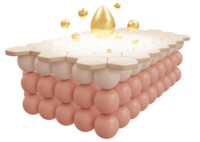
Skin does not function in one layer, and the most defensible formulations are no longer designed as though it does. The shift toward multi-depth formulation strategy reflects a more sophisticated understanding of how actives interact with skin biology, and why targeting a single mechanism, at a single depth, consistently underdelivers against what the science makes possible.
The epidermis and dermis present fundamentally different biological environments. Cell renewal, pigmentation control, and barrier function are epidermal processes. Structural protein synthesis, ECM integrity, and dermal volume are governed below. An active that addresses one without supporting the other leaves measurable efficacy unrealized. When chemistry that brightens works in concert with the natural keratinocyte renewal cycle rather than independently of it, correction is faster and more complete. When collagen-signaling actives are paired with epidermal support ingredients that maintain the permeability conditions for penetration, the dermal outcome is more reproducible and clinically stronger.
A first-in-class active targeting the skin ubiquitin-proteasome system, the cellular protein quality control pathway responsible for clearing damaged and misfolded proteins that accumulate with photoaging and chronological aging. It is supported by strong clinical substantiation across both in vitro pathway validation and in vivo efficacy endpoints, offering meaningful mechanistic differentiation within the anti-aging active category.
Targets the dermis by supporting extracellular matrix protein synthesis, including collagen and fibronectin production at the fibroblast level, improving structural firmness and contour.
Targets the dermis by supporting extracellular matrix protein synthesis, including collagen and fibronectin production at the fibroblast level, to improve structural firmness and contour.
Science Builds Sustainability More Credibly
The biotech ingredients category offers a structural solution to the sustainability tension in personal care. Performance and environmental responsibility are not trade-offs, but co-produced. Naolys plant cell biotechnology is a clear example of how the production method itself becomes a sustainability credential.

Resource Efficiency
Natural resources are conserved at the source. A single plant tissue sample establishes a genetically stable cell bank capable of producing a continuous supply of active material. There is no need for repeated harvesting, agricultural cycles, or land conversion.
Rare Species Protection
Rare, endangered, or slow-growing plant species can be utilized without field cultivation or harvest pressure. Cell culture production removes dependence on traditional agriculture and protects vulnerable ecosystems.
Land Use Reduction
Large-scale cultivation is no longer required. Land typically used for cosmetic ingredient production can be redirected to food systems, biodiversity support, or carbon sequestration.
Input Elimination
The process avoids pesticides, herbicides, and synthetic fertilizers. A closed bioreactor system prevents the environmental impact associated with conventional agriculture.
Water Optimization
Water use is significantly reduced. Field irrigation is eliminated, and process water is controlled and optimized within the production system, offering a clear advantage in water-stressed regions.
2026 Is the Year
Science Becomes the Differentiator
The market is no longer debating natural vs. synthetic. The ingredients leading are engineered with purpose. The brands thriving are those that can show their work. Glenn’s role is to help you navigate this shift with clarity, credibility, and cutting-edge science.










Leave A Comment
You must be logged in to post a comment.